Ghana Is Being Built Into Africa's AI Capital. Here's What That Means for Your Business Now.
By Enoch Adu Marfo
Ghana just became Africa's AI testing ground — a $1B UAE hub, Google's new Applied AI Lab, and 120K coders in training. Here's what it means for you.
In May 2025, Ghana signed a $1 billion deal with the UAE to build the Ghana-UAE Innovations and Technology Hub — a 25-acre AI and tech campus in Ningo-Prampram, funded by Dubai's Ports, Customs and Free Zone Corporation, designed to pull in over 11,000 firms including Microsoft, Meta, Oracle, IBM, and Alphabet, and projected to create more than 100,000 jobs. Construction on phase one begins this year, with completion targeted for 2028.
In April 2026, President Mahama launched Ghana's National AI Strategy — a ten-year roadmap (2025-2035) — alongside a $250 million Cabinet-approved investment in a national AI Computing Centre, and the nationwide rollout of the One Million Coders Programme: 130 training centres, all 16 regions, 6,500 laptops distributed on day one from a 20,000-device government stock (with MTN Ghana chipping in $2 million for 2,000 more). By May, nearly 120,000 people had registered, with roughly 30,000 already enrolled.
And on July 1 — two days ago — Google stood on a stage in Johannesburg and named Ghana specifically: the Google Africa Applied AI Lab, based at the Accra AI Community Centre, backed by the Google AI Futures Fund and four venture firms — Novastar Ventures, 4DX Ventures, Norrsken22, and Ventures Platform — is now taking applications from African founders and researchers for early access to Google's most advanced models.
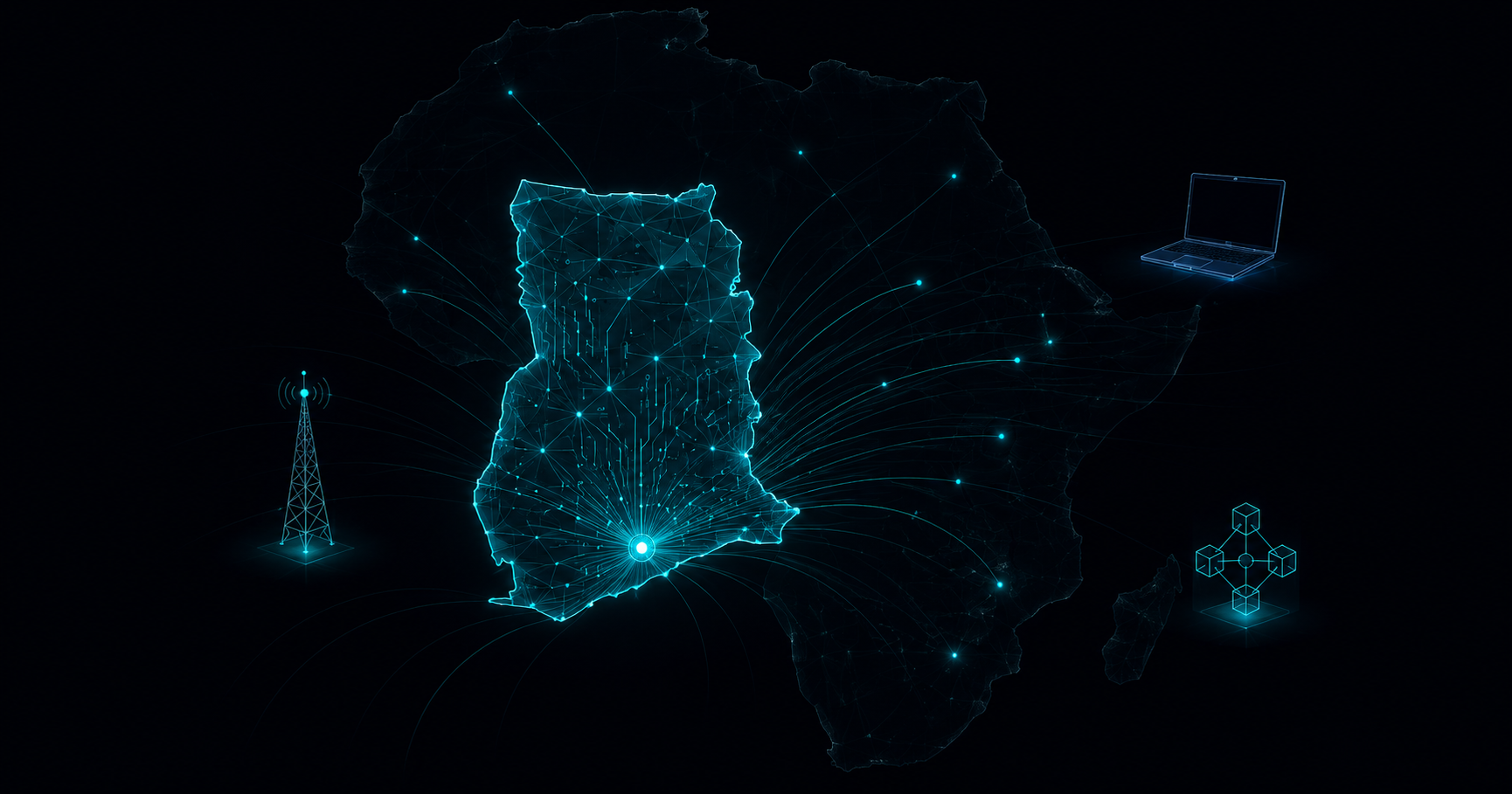
Put those three together and the pattern is unmistakable: Ghana isn't hoping to participate in Africa's AI moment. It is being built, deliberately and with serious capital, into the country that leads it.
Why this matters beyond the headlines
It's tempting to read all of this as government and Big Tech theatre — announcements that make good press but change little for the business trying to make payroll this month. That reading is wrong, and it's an expensive mistake to make.
Infrastructure precedes adoption. Every wave of digital transformation — mobile money, e-commerce, cloud computing — followed the same sequence: the rails get built, a small number of businesses plug in early and capture disproportionate advantage, and then the rest follow years later at a structural disadvantage. Ghana's AI rails are being built right now, in 2026, with named capital, named partners, and named timelines. The GSM Association estimates AI could add up to $2.9 trillion to Africa's economy by 2030 — provided access to data, computing infrastructure, and digital skills keeps improving. That "provided" is exactly what these three initiatives are engineering into existence.
What this means for your business, concretely
You don't need to be a startup founder applying to Google's Lab, and you don't need to wait for the Ningo-Prampram campus to open in 2028, to benefit from this moment. Three things are true right now, today:
First, the talent pipeline is about to get materially deeper. With 120,000+ Ghanaians already registered for AI and coding training, businesses that build AI-literacy into their hiring and operations now will have a growing pool of trained people to draw from — and a head start on knowing what to ask for.
Second, the cost of building AI-powered tools into your business is falling. Between the AI Computing Centre, the coming Ghana-UAE hub, and the deeper cloud/AI infrastructure Google and others are investing in across the region, the technical and cost barriers that made "AI for my business" feel like a Silicon Valley luxury are eroding fast.
Third, and most urgently: perception is shifting internationally. Ghana is being written about — by Google, by international press, by venture capital — as Africa's AI hub. Businesses that visibly build on that positioning now (in their marketing, their product, their own AI adoption story) get to ride that narrative. Businesses that stay quiet get lumped in as followers, regardless of what they're actually doing internally.
The real question
The strategy is national. The infrastructure is being funded in the billions. The question every Ghanaian business owner should be asking isn't "will AI change how I operate" — that's already decided. It's: will you be one of the businesses that plugged in during the build-out, or one of the businesses still asking what happened, three years from now, when it's already normal?
At DeMario Glow, we built our entire agency around being ready for this moment before it arrived. If you're wondering what "Ghana's AI Strategy" means for your specific business, that's a conversation worth having now — while the advantage of moving early is still available.
Enoch Adu Marfo is the founder of DeMario Glow, an AI-powered digital transformation agency based in Adenta, Accra, serving clients across Ghana and worldwide.